

11,000 Strings: A 50-Piano Spectacle at the Park Avenue Armory, with Hailun Part of this History
- Apr 20
- 5 min read
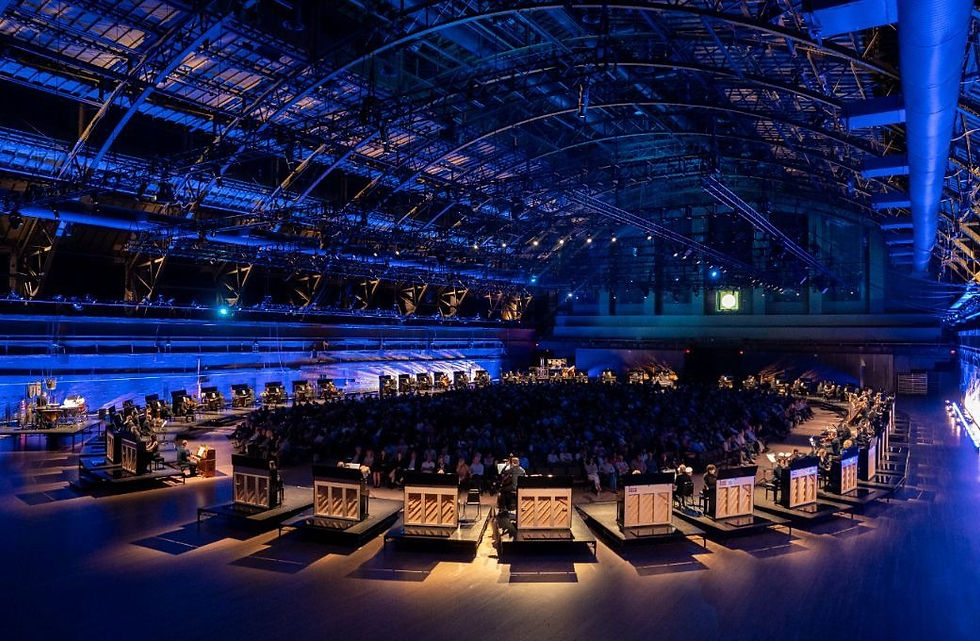
Georg Friedrich Haas turned a New York landmark into something you have never quite heard before.
Last fall, the Park Avenue Armory did something unusual, even by its own standards. The Wade Thompson Drill Hall — a 55,000-square-foot space that has hosted everything from large-scale art installations to immersive theater — was filled with 50 upright pianos, arranged in a circle around the audience. Not on a stage. Around you. And then they all started playing at once.
This was 11,000 Strings, the North American premiere of a piece by Austrian composer Georg Friedrich Haas, performed over six nights from September 30 to October 7, 2025. It is one of those events that is hard to describe to someone who was not there, but worth trying anyway.
The Composer Behind It
Georg Friedrich Haas was born in Graz, Austria in 1953, and has spent most of his career doing things with sound that do not quite fit into neat categories. He currently holds the MacDowell Professor of Music chair at Columbia University in New York, where he teaches composition. His music sits at a crossroads — he is rooted in the European tradition but has also been shaped significantly by American experimental composers like John Cage, Harry Partch, Charles Ives, and James Tenney.
What Haas is best known for, at least in contemporary music circles, is his use of microtonality — working with pitches that exist between the standard 12 notes of the Western piano. Interestingly, Haas himself pushes back on that label. He has argued that the whole concept of "microtonality" is flawed, because everything outside of the 12 standard pitches gets lumped into that category. His view is that he is not doing something exotic — he is just organizing sounds that already exist. That distinction matters if you want to understand where 11,000 Strings is coming from.
Where the Idea Came From
The seed for this piece was planted not in a concert hall, but in a factory. Peter Paul Kainrath, the artistic director of the Vienna based Klangforum Wien, was visiting a piano factory in China when he heard something that stuck with him: multiple pianos being played simultaneously, each slightly different from the next, creating a dense overlapping wash of sound. That experience eventually led to a collaboration with Haas and became the basis for 11,000 Strings.
The world premiere took place in Bolzano in August 2023, performed by conservatory and university pianists alongside the Mahler Academy Orchestra. The Park Avenue Armory presentation two years later, with Klangforum Wien, was its North American debut.
50 Pianos, 11,000 Strings
The title is literal. An upright piano contains roughly 220 strings. Multiply that by 50, and you get somewhere in the neighborhood of 11,000 — a single instrument in name only, distributed across an entire room.
For the Armory performances, all 50 upright pianos were provided by Hailun, which allowed for a level of consistency in the instruments that the tuning system required. And the tuning is where things get precise: each piano was tuned exactly two cents higher than the one next to it. Two cents is, by most accounts, the smallest difference in pitch that the human ear can reliably detect. Stack 50 of those increments on top of each other and the first piano and the last are separated by just under a full semitone — a near-circle of pitch, almost closing back on itself.
In performance, Haas treats all 50 pianos not as 50 separate instruments but as one. The piece was conducted in real time, with pianists following a score displayed on iPads.
What It Was Like to Be There
The format of 11,000 Strings is what the Armory calls an "installation concert." You do not sit facing a stage. The 50 pianists and the 25 musicians are arranged on a low platform that forms a ring around the audience. You are inside the music, not in front of it. With ensemble members placed at different points around the hall, the sound arrives from every direction, constantly shifting as different instruments come forward or recede.
The piece runs approximately one hour and six minutes with no intermission. Over that time, it moves through a range of sonic states — from quieter, almost suspended passages where individual notes seem to drift and settle, to denser accumulations where the sheer weight of all those strings in motion fills the hall completely.
Critical response was genuinely divided, which is probably the most honest thing you can say about a piece this unusual. Some reviewers found it intellectually impressive but difficult to connect with emotionally — a work that engaged the mind more than it moved the heart. Others described it as surprisingly beautiful, even strange in how affecting it became over time. One listener, by several accounts, said before the performance they had expected dissonance and came out having found something closer to consonance. That gap between expectation and experience seems to be where the piece lives.
Why Hailun
The decision to use Hailun pianos for this performance was not incidental. When a piece is built entirely around precise microtonal tuning — where every piano in the room needs to hold its specific pitch and stay consistent across the duration of a performance — the instrument itself carries a lot of responsibility. All 50 upright pianos used in the Armory performances were Hailun instruments, and the consistency across them is what made the tuning architecture of the piece possible in the first place.
That kind of reliability does not happen by accident. Hailun has spent years building instruments that can hold up under demanding conditions, and being chosen for a project of this scale and specificity — a North American premiere at one of New York's most respected performance spaces — reflects the level of trust the professional music world has placed in them.
For anyone thinking about what piano to invest in, that context is worth sitting with. These were not decorative props. They were the instrument. Fifty of them, asked to do something exceptionally precise, in one of the most acoustically unforgiving spaces in the city. And they delivered.
Why It Matters
What Haas and Klangforum Wien pulled off in New York was not just a concert. It was a demonstration of what happens when you take a familiar instrument — the piano — and fundamentally change the assumptions around it. The piano is usually one thing sitting in one place, making one kind of sound. Here it was 50 things, surrounding you, tuned to a system most audiences have never encountered, and treated as a single unified voice.
The Park Avenue Armory is one of the few spaces in the world that can hold something like this — not just physically, but in terms of the kind of artistic ambition it tends to invite. 11,000 Strings belongs in that conversation. Whether or not it moved every person who walked through the door, it asked real questions about what a piano concert can be, and it asked them loudly.
Sources: Park Avenue Armory · Klangforum Wien · New York Classical Review · Bachtrack · ArtNews · Columbia University


Comments